
There’s been a lot of talk recently about health savings accounts and high deductible health plans. In the debates, they are often touted as an answer for controlling health care spending. After all, if it’s your money in your account, you’re less likely to spend it. A recent study*, though, once again explains why this isn’t always a good thing:
Background: High-deductible health plans (HDHPs) are an increasingly common strategy to contain health care costs. Individuals with chronic conditions are at particular risk for increased out-of-pocket costs in HDHPs and resulting cost-related underuse of essential health care.
Objective: To evaluate whether families with chronic conditions in HDHPs have higher rates of delayed or forgone care due to cost, compared with those in traditional health insurance plans.
Design: This mail and phone survey used multiple logistic regression to compare family-level rates of reporting delayed/forgone care in HDHPs vs. traditional plans.
Participants: We selected families with children that had at least one member with a chronic condition. Families had employer-sponsored insurance in a Massachusetts health plan and >12 months of enrollment in an HDHP or a traditional plan.
The concern, one I’ve expressed on the blog a number of times, is that people aren’t very good at discriminating between necessary and unnecessary care. This is fine if you’re healthy, when pretty much all care is unnecessary. If you’re sick, though, then across the board care cuts can be bad.
This study looked at families with members who had chronic conditions, to see if they had delays or foregone care more often in an HDHP than if they had traditional insurance. The HDHPs had annual family deductibles between $1,000 and $6,000. In most of the plans, office visits did not eat into the deductible and were only subject to a $20 co-payment. Prescription drugs also had co-payments. Health savings accounts were coupled with the HDHPs most of the time, but not often funded by employers. Preventive services were always covered with no deductible and no co-pay.
The traditional plans, on the other hand, had no deductible. They had co-pays for office visits and drugs, but these were usually less than in the HDHP. Similarly, preventive services were fully covered.
The big difference, of course, is that those in the HDHP are spending their own money almost from first dollar. So they’re less likely to do so. Here is what they wanted to know:
The primary outcome variable was report of DFCC [delayed or forgone care due to cost] for adult or child family members in the prior 12 months. Subjects were asked whether they or a family member (1) was sick with an acute illness (defined as “when the symptoms do not last for a long period of time, like the flu or an injury”) and delayed going to the doctor’s office or did not go at all; (2) had considered going to the ED but delayed going or did not go at all; (3) delayed going to the doctor or did not go at all for a chronic condition (as defined above); (4) delayed going to get a checkup or did not go at all; or (5) delayed going to get a test or procedure or did not go at all. Subjects answering affirmatively were asked whether the delayed or forgone care was due partly or entirely to cost, and whether the family member was a child or an adult. The denominator for these measures was all study families.
Here’s what they found:
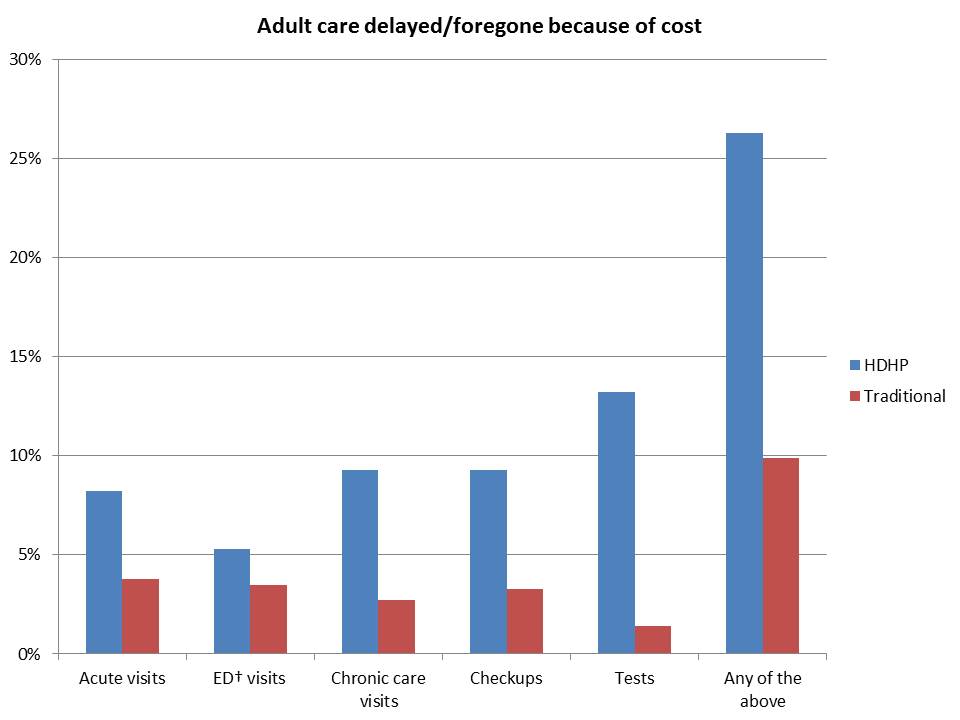
More than a quarter of adults had delayed or went without care because of cost. Adults were specifically more likely to delay or forego acute care visits, chronic care visits, checkups, and tests.
This study was new, though, in that it also looked at the effect of HDHP on children:
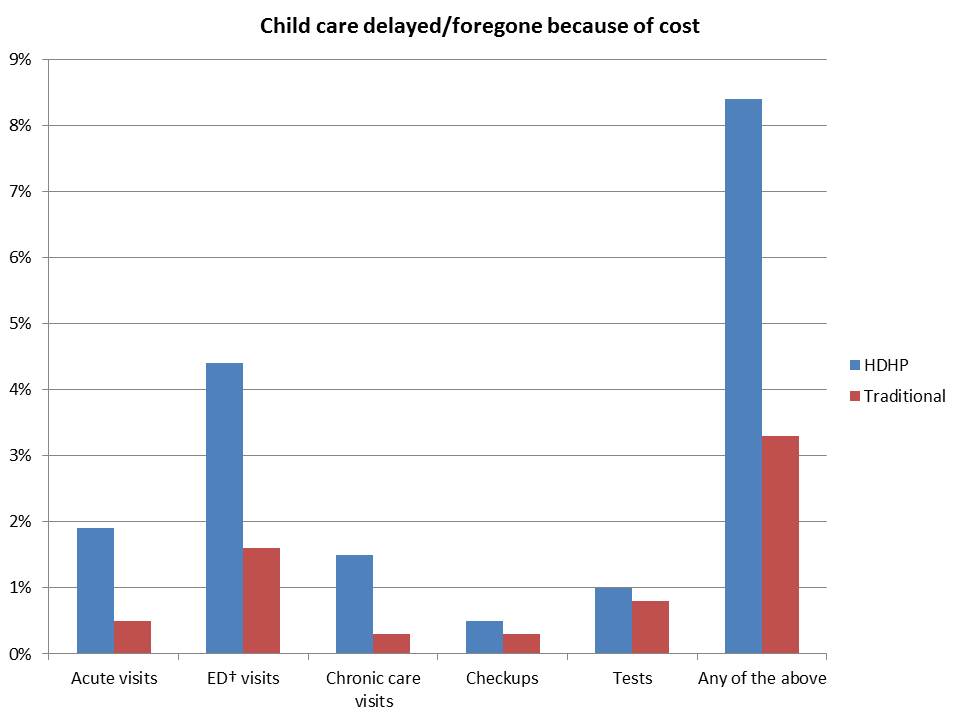
Children, like adults, were more likely to go without care, or have their care delayed, if they were in a HDHP. But in kids, the biggest difference was in the emergency department. Even when adjusting for other confounding factors, the chance of foregoing or delaying care for cost was significantly higher in HDHPs. It was also significantly higher if you were poorer.
Families with HDHPs forego or delay care because of cost, more so if they are below 400% of the poverty line. That can be a terrible thing. Granted, the study can’t tell if the care avoided was necessary or unnecessary. But when you look at families with members who have chronic conditions, the chance of care being necessary goes up. This has implications for the future. HDHPs will be part of the exchanges if the ACA doesn’t go away. We will need to continue to watch how patients under these types of plans fare.
*My usual disclaimer: One of the authors is a close, personal friend of mine. I maintain this doesn’t lessen the quality of her work.


by Sharon Williams on January 24th, 2012 at 10:00
It’s not just the chronically ill who feel the downside of high deductible health plans. I have high deductible. One simple case of bronchitis and I’m flirting with a $5000 bill with office visits, meds and tests including a cat scan, even though all the other tests showed it was just bronchitis. Can anyone say “overly defensive medicine”?
by Floccina on January 26th, 2012 at 16:58
Sharon Williams,
Though $5000 seems like a lot you could make that up in a reasonable amount of time with the difference in cost of a low deductible and high deductible plan.
by foosion on January 24th, 2012 at 10:39
>> Granted, the study can’t tell if the care avoided was necessary or unnecessary >>
This is the key point and can’t be fully answered by saying “the chance of care being necessary goes up.” Those who favor making consumers pay more would respond that much of healthcare is unnecessary and that this study helps prove it.
For example, why should those with a condition that quickly corrects (“symptoms do not last for a long period”) need medical care? Is there any evidence that delaying treatment for a cold or flu has any long-lasting effect?
We need studies that show that necessary care is being foregone or that those in HDHPs have worse outcomes (correcting any differences between those in HDHPs and traditional plans).
by Aaron Carroll on January 24th, 2012 at 11:48
Sure, but one of the only ways to do that would be an RCT, which is expensive and time consuming. Plus, it’s already been done. We’ve posted on the RAND HIE numerous times, which showed that cost sharing led to decreased care, but increased death in poorer groups with certain chronic illnesses. There will likely never be another experiment on that magnitude unless the government decides to really invest in HSR research.
Any candidates that advocated for increased cost-sharing, but also for an increase in research to discover its effects, would get a lot less criticism from me.
by foosion on January 24th, 2012 at 11:56
Fair enough, but then I’m not sure what this study is adding to the mix
by Joe on January 24th, 2012 at 12:19
Agree with foosion on this one. This is an interesting topic, but the research does little more than raise awareness to an issue. There’s not too much in the way of useful data.
I’d be very interested to see hard data regarding specific chronic conditions. Claims patterns for certain types of care of specific chronic conditions can be to some extent. What has happened to claims and compliance when deductibles are raised on CDHP’s on these specific cases?
by Aaron Carroll on January 24th, 2012 at 12:47
It’s one of the first studies to look at children, so it interests me. Almost all of the research in this area focuses on adults.
by Brad F on January 24th, 2012 at 20:01
Aaron
I have never understood outcome generalizations with the RAND experiment. NON free care patients received less dental care and vision (marginally), and a reduction in BP.
Given all the metrics followed, it appears to me that over the years, the findings have, like a game of telephone, acquired greater mythical status at each retelling. Most folks assign greater strength to the findings. Its not so. I hate to say distortion, but at times, yes, thats the way “RAND” is thrown around.
Outside of ideological reasons, why is this so?
Brad
by JayB on January 28th, 2012 at 12:00
“HARTFORD, Conn., January 10, 2012 — Employers that replaced their traditional health benefits plans with Aetna HealthFund® consumer-directed plans saved $21.8 million over a five-year period for every 10,000 members, based on a recent study of Aetna (NYSE: AET) health care claims and utilization. While members with Aetna HealthFund plans spent seven percent less on overall health care costs, the study also showed that these members received more preventive care from their primary care physicians and preventive screenings than members with traditional Preferred Provider Organization (PPO) plans.
• Aetna HealthFund members received screenings for cervical cancer, colorectal cancer, and prostate cancer, as well as mammograms and immunizations, at a higher rate compared to members in PPO plans.
• Members with Aetna HealthFund plans who have diabetes received the appropriate screenings for their blood sugar (Glycated Hemoglobin A1C test) and cholesterol (lipid screening) more frequently than diabetic members in PPO plans.
• Aetna HealthFund members with chronic conditions such as diabetes, congestive heart failure, high blood pressure and high cholesterol use the prescription drugs necessary to treat their conditions at similar rates as PPO members.
• Aetna HealthFund members use generic drugs at a higher rate than members in PPO plans, allowing members to reduce their prescription drug costs and generating approximately four percent pharmacy cost savings for employers. ”
http://www.aetna.com/news/newsReleases/2012/0110-Aetna-HealthFund-Study-Results.html
http://www.aetna.com/news/AHF_study.pdf
by KarenInOhio on January 24th, 2012 at 11:37
Here’s the thing though – so often most I know have always been somewhat reluctant to go to the doctor for things that they might consider they can get through. But it really is more cost productive and probably better outcomes to catch an illness sooner than later. There are some things, especially in children that can kill quickly that might mimic the “flu”. It seems like there should be a middle ground where sick visits are covered better before a deductible is met or perhaps a two-tier deductible of some sort. Even those with employer contributions often have a gap of thousands of dollars that they must contribute to their HSA or out of pocket. For many, thousands of dollars are not sitting around. I really question that bringing sick folks to the doctor when sick is the reason health care costs are out of control.
by foosion on January 24th, 2012 at 11:59
>>I really question that bringing sick folks to the doctor when sick is the reason health care costs are out of control.>>
I believe the vast majority of healthcare spending is major items in which the patient has no real choice. That seems to me the major problem with this whole theory. We might save a whole lot on things that don’t cost much, but it does nothing about the expensive items. Most people don’t shop around after having a heart attack.
by BillNRoc on January 24th, 2012 at 14:18
>I believe the vast majority of healthcare spending is major items in which the patient has no real choice.<
Maybe not. But hospital care and physician/clinician services account for 2/3 of the health care paid for by insurance (private and Medicare). And the Dartmouth Atlas studies have shown that there are unwarranted regional variations in hospitalization rates and specialist treatment rates that largely reflect the supply of hospital beds and specialist MDs in a community. Patients may not feel they have a choice about accepting treatments or procedures recommended by MDs, but as this blog has said before, a lot of those recommendations are eminence-based rather than evidence-based.
As for out-of-pocket costs, the top 3 categories are: dental care, other medical products, and Rx drugs. And don't forget the US's high rate of personal bankruptcy due to medical expenses. HDHP advocates don't like to recognize that.
by Floccina on January 26th, 2012 at 17:05
>I believe the vast majority of healthcare spending is major items in which the patient has no real choice.<
If that is so, then why are premiums for high deductible plans so much lower?
by Brian Lanier on January 26th, 2012 at 20:08
I would like to suggest that they are lower because the vast majority of people are not in the hospital at any one time, nor are they likely to require hospitalization at a given time. In general, health insurance is expensive because people have become convinced that someone else should pay for everything (minus a $10 copay) when in reality the high costs of “comprehensive” plans are passed on to those same people through higher deductibles, or wages that have been stagnant for three decades. This has been compounded by the fact that this system had degraded the ability of primary care physicians to properly manage chronic disease, to deal with complex problems (hence increased sub-specialty referrals) or to inspire behavior that avoids it in the first place.
by Don Levit on January 24th, 2012 at 12:39
An effective way to reduce costs: eventually raise the deductible.
Raise it to $25,000 cuts the premium by 60%.
Raise it to $50,000, cuts the traditional premium by 80%.
How to fill the gap: with a primary plan that builds $10,000-$20,000 of coverage, depending on contributions made.
Don Levit
by Brian Lanier on January 24th, 2012 at 15:06
One reason that HDHPs have gotten a bad rap is that there is not sufficient infrastructure for patients that pay directly for the majority of their care to receive low-cost, high-quality care. Essentially, they still are stuck in the insurance-driven, volume-based environment that has devalued the patient relationship and is driving med students into hight-paying sub-specialties and family physicians into early retirement.
Direct-pay practices such as MedLion, Qliance, and Access Healthcare in Apex NC have demonstrated that quality primary care is very affordable once the waste associated with accepting third-party reimbursement is abandoned. These physicians have the time to build relationships with patients, which is required to successfully prevent and manage chronic disease. It is my expectation that as these types of practices continue to grow that their benefits will be unavoidable to policymakers.
by Jay B on January 24th, 2012 at 16:21
“And don’t forget the US’s high rate of personal bankruptcy due to medical expenses. HDHP advocates don’t like to recognize that.”
-Not sure which study you are referring to, but didn’t the benchmark study include any bankruptcy filing with over $1K in medical debt as a medical bankruptcy, without considering the magnitude of other debts.
“The second section of Exhibit 2 reports the number of respondents who had a variety of medical-related problems, such as illness causing a loss of at least two weeks of income, and medical bills in excess of $1,000 in the previous two years. The authors counted these as medical-related reasons for bankruptcy even if the respondents did not state that illness or injury was a reason for bankruptcy. They thus concluded that 54.5 percent of respondents had medical bankruptcies. ”
http://content.healthaffairs.org/content/25/2/w74.full
-Even if every penny of your health care costs is covered by insurance, disability during or after a major illness can easily put a family under unless the primary breadwinner is covered by a rock-solid disability policy.
-With regards to people with chronic conditions foregoing necessary care, it seems as though this is something that could be dealt with quite easily via plan design. E.g. identify people with conditions where covering appropriate preventive measures reduces the total costs to the plan.
by MATT on January 24th, 2012 at 23:00
How are they jumping to the conclusion that the foregone care was necessary? Chronic conditions shouldn’t be ending up in the ER that often, while ER overuse remains high.
by Dennis Kelly on January 26th, 2012 at 14:12
In reading your observations I find that you have assumed that people with traditional HMO and PPO plans have more coverage than those of someone with an HDHP. In fact a person with an on-going cronic illness in their family actually benefits from a HDHP where maximum out-of-pockets are met and all care is then provided on a 100% coinsurance basis. Many times it is a single individual within a family that can and should use the majority of HRA or spending account resoures to pay their HDHP out of pocket expenses and have 100% of control of their special health care needs.
Never ending co-pays and primary care referal requirements are forms of rationing that many people with cronic illnesses are subject to becuase people have been lead to believe someone else should pay for their health care.
Do the math. HDHP reduce the cost of insurance and increase my control and access to my doctors when I really need them. That is when I am really ill.
Thank you for your blog and giving me an opportunity to contribute. Remember the most expensive insurance you can buy is insurance you don’t need.
Dennis Kelly,
by JayB on January 26th, 2012 at 19:50
Greg Scandlen has posted a critique of this paper that you may be interested in:
http://healthblog.ncpa.org/a-curious-little-study/#more-23623