
Matt Yglesias points out that health care costs have to go up, since something has to go up when you’ve got more to spend. Austin adds his take on this here.
I don’t disagree with the premise of what Matt is saying. Of course, when you have more money, you’re going to spend more on health care. Richer countries should spend more money on health care, just as they spend more money on everything else. The question is how much more? So let me show you this slide for a class I’m teaching this afternoon, made from OECD data:
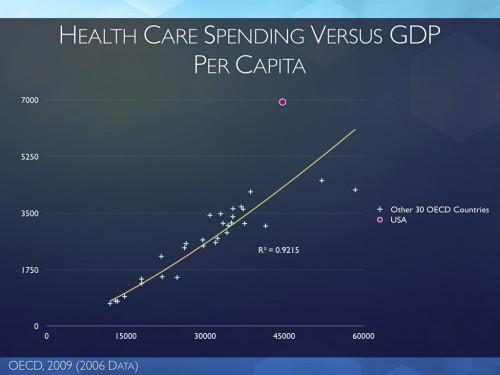
What you are looking at is GDP per capita on the x-axis, and health care spending per capita on the y-axis. It makes sense that countries with more money (in GDP) will spend more on health care. In fact, that’s what happens. The 30 non-US OECD countries line up in a pretty good line, with increasing spending per person as their GDP gets higher. In fact, as I show in the chart, you can make a pretty good line that fits the relationship between GDP and health care spending.
Notice two things, however. The first is that Norway and Luxembourg (the two countries farthest to the right), fall below the line. This is because – presumably – at some point you can spend more money, but what’s the point? The drugs won’t work better, the advice is still the same, and the doctors can’t do any more. At some point, spending more is just waste, because the outcomes don’t get any better.
The second thing to notice is the US. You can’t miss it. It’s the big red dot that’s way at the top. We’ve chosen to ignore what I just said.
It’s not that we shouldn’t spend more than other countries. We should. We are richer than almost anyone, and we should spend more on health care. The problem is that we’re spending so much more than everyone else, even after taking into account our GDP. We’re literally off the chart. And we’re not getting better outcomes for that money.

by Mark Spohr on February 24th, 2011 at 16:44
This graph says it perfectly. We should be like Norway or Luxembourg (or Switzerland which has a health insurance system close to the ACA design).
They all spend less than we do and get better health. We have a health industry driven health system which focuses on delivering profit, not health.
by Dan Beachler on February 24th, 2011 at 20:28
I agree with you about the outcomes, but I wonder if it’s valid to assume a linear relationship here. Maybe with all the extra GDP per capita the US would rather spend their extra money on healthcare. So maybe we should be fitting an exponential line instead of assuming a linear relationship?
Norway and Luxembourg argue more for the linear relationship, but it’s to base conclusions on such small populations.
by Austin Frakt on February 24th, 2011 at 20:53
@Dan Beachler – The relationship plotted is actually quadratic (you can probably discern the curvature if you stare at it long enough). One can try other functional forms, but it is hard to escape the qualitative conclusion that we spend a great deal more of our wealth than do other nations and have little additional, broadly measurable quality for it.
It’s also hard to escape the problems health care financing is causing for states and the federal government (not to mention businesses and families). We just don’t seem willing to pay for it through higher taxes. Something has got to give.
by Austin Frakt on February 24th, 2011 at 20:54
I see that Aaron and I commented at the same time. I thought the line was quadratic. He says exponential. It’s his plot, so I yield.
by Aaron Carroll on February 24th, 2011 at 20:52
Dan Beachler,
Actually, that’s an exponential line there already. It’s a slight curve, not linear. That’s the fit of all the countries but the US. If you include the US, it doesn’t look much different.
In order to believe that the US is following the same rational rule, then you have to believe that (1) Luxembourg and Norway are way underspending and (2) that if the rest of the countries could increase their GDP a little more, they’d start spending WAY more than they are now.
There’s no evidence for either of those things. A much simpler explanation is that we are over-spending.
by Aaron Carroll on February 24th, 2011 at 21:13
Oops. It is quadratic. My bad. I went back and checked. Austin was right.
by Dan Beachler on February 24th, 2011 at 23:31
Thank you for your responses Aaron and Austin. It does look less linear now that I stare at it a little more.
I do agree with the overall conclusion that the US is not getting much if anything from all that extra spending. However, I do think the functional form of the line can play a strong role in how one could interpret how much is overspent.
see: http://datadrivendecision.blogspot.com/2011/02/is-us-extreme-outlier-in-healthcare-per.html
(or here for the blown up version: http://3.bp.blogspot.com/-iM_MgB4kZ04/TWcsZ8FOoGI/AAAAAAAAAUw/gkm4SVMRJLM/s1600/HealthperGDP_linearexp2.jpg)
by Aaron Carroll on February 24th, 2011 at 23:40
Dan Beachler,
That argument has been made before. I’ll wager, however, that one of those lines you made has a much better fit than the other. The relationships that attempt to make the US look better always are a stretch.
I examined a number of relationships, and this was the best one.
by Dan Beachler on February 25th, 2011 at 00:33
The fit you used does look better, but it’d be interesting too compare different models using something like AIC (and also seeing if removing Luxembourg had any effect).
by garyb on February 25th, 2011 at 08:21
The data is irrefutable, but the solution isn’t.
It’s this argument that’s so frustrating:
The US spends more than any other country and the outcomes are no better therefore we must go single payer.
Perhaps it’s the culture of paying physicians and specialist so much more than Europe. Perhaps the culture demands excessive spending in the final years/weeks/days of life.
Wonder what the data shows for spending v. GDP per capita for age greater than say, 65 or 75.
by edawg on February 25th, 2011 at 08:59
“We’re literally off the chart.”
Uh, I see the chart. I see us on the chart. *Literally* we’re on the chart.
by Aaron Carroll on February 25th, 2011 at 09:54
@Dan Beachler,
Already done. See: http://theincidentaleconomist.com/wordpress/expected-spending-above-gdp/
The fit is actually better without them.
@garyb,
I don’t disagree with you, which is why I didn’t make that argument!
@edawg,
When I first made the chart, without the US, and then added in the US, we were “off the chart”. I had to then alter the y-axis to make the US appear. Permit me a little literary leeway.
by Tom in NC on February 25th, 2011 at 12:10
If you take out the 25%+ on administration that we pay in this country to for-profit insurance companies, our spending on health care would be high, but more in line with GDP. Take out the premium that we pay for prescription drugs, and we would look pretty good — even with all the technology and cost of defensive medicine.
by Matt C on February 25th, 2011 at 13:00
It is possible, though, that Luxembourg and Norway dramatically underspend on healthcare relative to GDP, while the US overspends some but not as much as suggested withbthis model. In the case of Norway, for example, I believe they spend more on Defense per capita than any other nation in the world. Maybe that’s where they have allocated their additional wealth. I also don’t feel it is appropriate to compare a country like the United States to a country like Luxembourg in anything, for obvious practical reasons.
What I would be really interested in seeing is a similar graph comparing the non-Medicare, non-Medicaid population in the US against similar population from the countries included in this analysis. I know that might be hard or impossible to acquire the data for such an analysis. Similarly, I think it might be more practical to compare per capita spending by state in the US versus these countries. I have an issue with how the US is always assumed to be one homogenous entity, when it is so unique in it’s composition that it can’t really ever be treated like a Norway or Switzerland.
by John Emerson on February 27th, 2011 at 10:17
Norway ranks 12th in per capita defense spending:
http://www.wisegeek.com/what-countries-have-the-highest-military-expenditures.htm
To show that Norway and Luxembourg underspend you’d have to provide some evidence.
The US isn’t homogenous but it’s one country and a lot of policies are national. You could compare to Canada, also no homogenous, and you’d get similar results. Looks like American exceptionalism is at work here.