
The Incidental Economist

The health services research blog


  • About the blog
  • FAQ
  • Podcast archive
  • Site policies
  • TIE-U
  • Masthead

    Editors in Chief
    Austin Frakt twitter facebook email
    Aaron Carroll twitter facebook email

    Managing Editor
    Adrianna McIntyre twitter facebook email

    Contributors
    Kevin Outterson twitter email
    Bill Gardner Google+twitterfacebook email
    Nicholas Bagley twitterfacebook email
    Other Contributors
  • Recent posts

    • Healthcare Triage: TANF, Cash Assistance, and How Work Requirements Effect Poverty Relief
    • Come hear the Mystic Brass Ensemble
    • Healthcare Triage News: Women on Web Move to Increase Access to Abortion Pills in the US
    • Healthcare Triage Podcast: Of Zebrafish and Diabetes
    • Who knew difference-in-differences could be so complicated?
    • Judges Shouldn’t Have the Power to Halt Laws Nationwide
    • A Sense of Alarm as Rural Hospitals Keep Closing
    • Healthcare Triage: Carrot vs Stick – The Social Safety Net, the Earned Income Tax Credit, and Work Requirements
    • Healthcare Triage: Is the Apple Watch a Health Device or What?
    • Healthcare Triage News: Most People Don’t Need Vitamin D Supplements
  • Archives

  • For speaking inquiries


    Interested in having Aaron or Austin speak to your group?

    For information on Aaron speaking, click here.

    For information on Austin speaking, contact the Leigh Bureau.

  • Aaron’s stuff

    Selected appearances:
    The Colbert Report
    Good Morning America
    Sound Medicine (most recent)
    The Ed Show

  • Austin’s stuff

    Click here for links to Austin’s peer-reviewed publications and/or related posts.

  • Losing weight won’t solve the health care cost crisis

      August 26, 2011 at 11:04 am
      Kevin Outterson

    Research says: Obesity is a problem, but solving it doesn’t fix our health care spending problem, just a very small step in the right direction.

    After Aaron’s fat-laden post on the “food” at the Indiana State Fair, The Lancet released a thoughtful issue on obesity, including estimates that obesity-related health costs in the US will reach $28 billion in 2020.  Wang YC, McPherson K, Marsh T, Gortmaker SL, Brown M.  Health and economic burden of the projected obesity trends in the USA and the UK.  The Lancet 2011;378:815-25 (gated). This sounds like a lot until you compare it to US NHE in 2020:
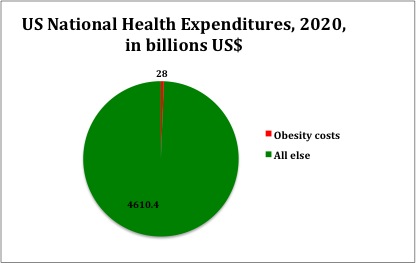
    Sources:  Wang YC, et al. Lancet 2011;378:815-25 ($28 billion); US NHE, 2020, table 1.

    More obesity news from The Lancet:  experts have underestimated how significant calorie reductions need to be in order to lose sustained weight.  The new models call for daily caloric reductions in range of 30 – 40% for very significant weight loss (ie, a 220 pound sedentary man reducing his 3000 calorie/day diet down to 1800 per day, in order to lose 44 pounds in 6 months).  Hall KD, Sachs G, Chandramohan D, Chow CC, Wang YC, Gortmaker SL, Swinburn BA.  Quantification of the effect of energy imbalance on bodyweight.  The Lancet 2011;378:826-837 (gated).

    Bottom line:  very significant reductions in US caloric intake will save 0.6% of health care costs by 2020.

    Aaron’s 2010 posts (the blame du jour) and (I’m not saying obesity isn’t a problem) reached similar conclusions.

    UPDATE:  Sarah Kliff, writing over at Ezra’s place, covered the same studies. Everything she writes correctly reflects the articles. And yet, our posts are very different.

    Share this...
    Tweet about this on Twitter
    Twitter
    Share on Facebook
    Facebook
    Share on Google+
    Google+
    Email this to someone
    email
    Comments closed
     
      Economics, Health Policy
      health care costs, obesity
    • Comments (2)

    • by Node Bunny on August 26th, 2011 at 14:26

      This article is ridiculous, sure actual obesity costs are probably a small fraction of overall health costs… but the larger costs come in the form of other health issues caused by obesity — diabetes, cardiovascular disease, etc etc…

      [top]
    • by Kevin Outterson on August 26th, 2011 at 15:27

      First, go read The Lancet article. The prime contributors to their projected costs are increased CVD, diabetes, and cancers.

      [top]
    Loading

  • Follow the blog

    rss Google+ twitter facebook

    Why all these options?

  • TIE Books


    Dont-Put-That-in-There
    Amazon.com
    Barnes & Noble
    Indiebound
    iBooks
    Google
    Kobo


    Dont-Put-That-in-There
    Amazon.com
    Barnes & Noble
    Books-A-Million
    iBooks
    IndieBound
    Powells


    Buy at Amazon.com
    Summary

    Excerpt: Economic profit
    Excerpt: Diminishing marginal utility
    Excerpt: Four factors of production
    Excerpt: Monopoly marginal revenue
    Excerpt: Consumer/producer surplus


    Don't Cross Your Eyes!
    Amazon.com
    Barnes & Noble
    Books-A-Million
    Borders
    IndieBound
    Powells


    Don't Swallow Your Gum!
    Borders
    Barnes & Noble
    IndieBound
    Amazon.com
    Books-A-Million
    Powells

    Austin and Aaron are participants in the Amazon Services LLC Associates Program, an affiliate advertising program designed to provide a means for sites to earn advertising fees by advertising and linking to amazon.com.
  • Tag cloud

    ACA AcademyHealth access accountable care organizations Affordable Care Act announcement blogging cancer comic competitive bidding costs cost shifting deficit employer-sponsored health insurance health care costs Healthcare Triage health insurance health insurance mandates health reform hospital readmissions hospitals individual mandate insurance exchange market power Massachusetts Medicaid Medicare Medicare Advantage mortality nutrition obesity On The Record physicians politics PPACA premiums prescription drugs quality reading list reflex RWJF spending uninsured Upshot vaccines
Work posted here under copyright © of the authors.

Details on the Site Policies page.

© 2018 The Authors*