
The Incidental Economist

Contemplating health care with a focus on research, an eye on reform.


  • About the blog
  • FAQ
  • Podcast archive
  • Site policies
  • TIE-U
  • Authors

    Austin Frakt Google+ twitter facebook email
    Aaron Carroll twitter facebook email
    Kevin Outterson twitter facebook email
    Harold Pollack twitter facebook email
    Bill Gardner Google+ twitterfacebook email
    Other Contributors
  • Recent posts

    • Is medication nonadherence a medical condition?
    • Levy and Meltzer on the impact of health insurance on health
    • Compounding pharmacy bills
    • Copayments are stupid, ctd.
    • Should very young children be taking stimulants?
    • GDP vs health care spending
    • The medical device tax needs to stay
    • More comparative effectiveness goodness
    • Fluoridation
    • How to debate a wing nut
  • Archives

  • For speaking inquiries


    Interested in having Aaron or Austin speak to your group?

    For information on Aaron speaking, click here.

    For information on Austin speaking, click here.

  • Aaron’s stuff

    Selected appearances:
    The Colbert Report
    Good Morning America
    Sound Medicine (most recent)
    The Ed Show

  • Austin’s stuff

    Click here for a link to Austin's CV, as well as a complete list of his peer-reviewed publications with links to related posts and/or ungated versions (when available).

  • Worthwhile Canadian initiative: report cards!

      10 comments
      April 10, 2012 at 12:00 pm
      Austin Frakt

    The Conference Board of Canada has recently updated its Health Outcomes by Country report cards using the latest data from the OECD. They score themselves a B. Guess which country is at the bottom of the list?
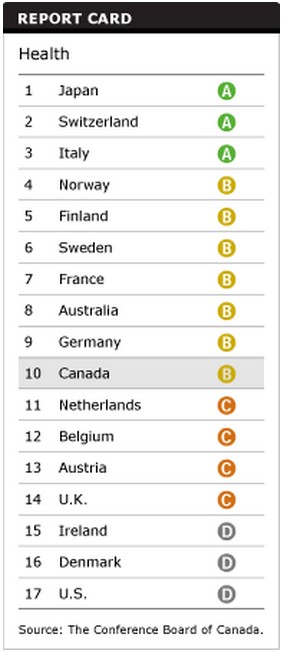
    The details are here. I wrote about a prior version of this report card in 2010.

    Interestingly, the U.S. is near the top (2nd) in self-reported health status–we say we’re healthy–but in all other measure we’re near the middle or bottom of the pack. Canada, as it turns out is number one in self-reported health status, despite having relatively little to crow about itself (other than, perhaps, being not as bad as the U.S.). Looks like North America has a superiority complex. On the other hand, it’s hard for dead people answer survey questions. The U.S. is last in infant mortality (Canada is nearly so) and life expectancy.

    @afrakt

    TwitterFacebookDiggDeliciousStumbleUponShare
      10 comments on this post
     
      Health Policy
      health outcomes
    • Comments (10)

    • by BillNRoc on April 10th, 2012 at 12:01

      But Austin, everyone “knows” the US has the best health-care system in the world. This data must be French, or something.

      Unless you define “best” as: paying specialist MDs and hospitals and drug makers and device makers and insurance executives very handsomely, without regard for the outcomes of the treatments they provide (or pay for) — with that definition, the US surely is the “best.”

      Reply

      [top]
    • by Mike on April 10th, 2012 at 12:09

      Man, reading through all of those reports is depressing. America is last on society, last on health, last on environment, and second-to-last on education. I need to down a carton of ice cream after that.

      Reply

      [top]
    • by Floccina on April 10th, 2012 at 14:01

      Switzerland and France have healthcare systems similar to that of the USA. (http://www.theatlantic.com/business/archive/2012/03/france-and-us-health-care-twins-separated-at-birth/254033/)

      Also I bet that some states, like Utah and North Dakota would do very well by the criteria.

      Here are the criteria that they use:

      To measure health performance, we evaluate Canada and 16 peer countries on the following 11 report card indicators: life expectancy; self-reported health status; premature mortality; mortality due to cancer; mortality due to circulatory disease; mortality due to respiratory disease; mortality due to diabetes; mortality due to diseases of the musculoskeletal system; mortality due to mental disorders; infant mortality; and mortality due to medical misadventures.

      We in the USA:

      Drive more = more road fatalities and injuries
      Have more homicide = more early death and injuries
      40 years ago smoked more – there is about a 40 year delay in smoking deaths
      Get more fertility treatments = higher infant mortality
      Have more citizens of Africa decent who have lower birth average weight and higher infant mortality. Note Hispanics have higher average birth weights and lower that average infant mortality despite having less access to medical care.
      The mentally ill have more rights.
      We have more war injuries and deaths.

      We do have a problems with cost and access though.

      Reply

      [top]
      • by joe on April 10th, 2012 at 21:06

        To floccina,
        Any sources to back up your disinformation? or did you just make that all up?

        Reply

        [top]
        • by Floccina on April 11th, 2012 at 10:32

          Hi Joe,
          Here are some links:

          http://blogs.reuters.com/james-pethokoukis/2009/08/20/turns-out-us-healthcare-system-is-actually-like-really-good/

          http://www.statehealthfacts.org/comparemaptable.jsp?ind=784&cat=2

          http://www.statehealthfacts.org/comparemapreport.jsp?rep=52&cat=17

          http://www.statehealthfacts.org/comparetable.jsp?cat=2&ind=48

          http://www.census.gov/population/projections/nation/summary/np-t7-b.pdf

          http://www.nytimes.com/2009/11/04/health/04infant.html

          http://en.wikipedia.org/wiki/Infant_mortality#Comparing_infant_mortality_rates

          That is not everything but it is a start.

          Reply

          [top]
        • by Floccina on April 11th, 2012 at 10:32

          Hi again Joe,
          If you want some info that I did not include please let me know and I will try to find a link.

          Reply

          [top]
        • by Floccina on April 11th, 2012 at 11:30

          I posed a reply with a bunch of link but they seemed to have dropped it.

          Reply

          [top]
          • by Austin Frakt on April 11th, 2012 at 11:32

            I see a reply from you to Joe with a lot of links.

            Reply

            [top]
    • by steve on April 11th, 2012 at 07:49

      Japan’s self reported health is the worst. Go figure.

      Steve

      Reply

      [top]
    • by JayB on April 12th, 2012 at 20:15

      -Here’s to hoping that someday someone will actually make an effort determine the extent to which the differences between the outcomes measured in each country are driven by how well the peopulation is taking care of itself, vs how well doctors and hospitals are taking care of them.

      Without that information, it’s not clear what anyone who wants to improve the performance of…doctors and hospitals is going to gain any useful insights from this kind of apples to oranges comparison. The average Asian American lives 2-3 years longer than the average Canadian. Is that because the health care that they get is better?

      -There’s *massive* variation from one cohort to the next within the US, and equally massive variations in the same geographic area. Does anyone think that the variations in infant mortality and life expectancy between say, Brookline and Dorchsester has anything to do with the performance of the BU Medical Center vs Beth Israel?

      -Danei et al (PLOS Medicine, 2010), and Murray et al (Plos Medicine, 2006) look at mortality variations and their physiological correlates in the US. Anyone surprised Danei et all find that smoking, high-blood pressure, diabetes, and obesity explain so much of the variation between the groups that Danei et al documented (35 years between the highest and lowest groups)?

      Once you control for deaths by murder, accidents, etc how much of the mortality variation between groups in the US can be explained in terms of anything that doctors and hospitals have a meanginful capacity to influence? The connection between access to medical care and the clinical efficacy of the care delivered is only loosely correlated with life expectancy in the US. It’s interesting that the default assumption seems to be that there’s a tight and meaningful connection everywhere else.

      http://www.plosmedicine.org/article/info%3Adoi%2F10.1371%2Fjournal.pmed.1000248#s4
      http://www.plosmedicine.org/article/info%3Adoi%2F10.1371%2Fjournal.pmed.0030260#pmed-0030260-g004

      Reply

      [top]

    Write a comment

    Click here to cancel reply.


    (Submission implies acceptance of comments policy.)

    Loading

  • Follow the blog

    rss Google+ twitter facebook facebook

    Why all these options?

  • TIE Books

    Don't Cross Your Eyes! Amazon.com
    Barnes & Noble
    Books-A-Million
    Borders
    IndieBound


    Don't Swallow Your Gum!
    Borders
    Barnes & Noble
    IndieBound
    Amazon.com
    Books-A-Million
  • Tag cloud

    AcademyHealth accountable care organizations Affordable Care Act announcement antitrust blogging books comic competitive bidding costs cost shifting deficit employer-sponsored health insurance health care costs health insurance health insurance mandates health reform hospital readmissions hospitals instrumental variables insurance exchange market power Massachusetts Medicaid Medicare mortality obesity On The Record physicians politics PPACA premiums premium support prescription drugs prostate cancer quality reading list reflex RWJF single payer spending substance use tax uninsured xkcd
Work posted here under copyright © of the authors.

Details on the Site Policies page.