The Incidental Economist

Contemplating health care with a focus on research, an eye on reform.


  • About the blog
  • FAQ
  • Podcast archive
  • Site policies
  • TIE-U
  • Authors

    Austin Frakt Google+ twitter facebook email
    Aaron Carroll twitter facebook email
    Kevin Outterson twitter facebook email
    Harold Pollack twitter facebook email
    Bill Gardner Google+ twitterfacebook email
    Other Contributors
  • Recent posts

    • Should very young children be taking stimulants?
    • GDP vs health care spending
    • The medical device tax needs to stay
    • More comparative effectiveness goodness
    • Fluoridation
    • How to debate a wing nut
    • Chart of the day: Cognitive ability and enrollment into public programs
    • Cutting the budget for inspections of compounding pharmacies
    • Sound Medicine: Why are employers offering health care incentives?
    • “Body Ritual among the Nacirema”
  • Archives

  • For speaking inquiries


    Interested in having Aaron or Austin speak to your group?

    For information on Aaron speaking, click here.

    For information on Austin speaking, click here.

  • Aaron’s stuff

    Selected appearances:
    The Colbert Report
    Good Morning America
    Sound Medicine (most recent)
    The Ed Show

  • Austin’s stuff

    Click here for a link to Austin's CV, as well as a complete list of his peer-reviewed publications with links to related posts and/or ungated versions (when available).

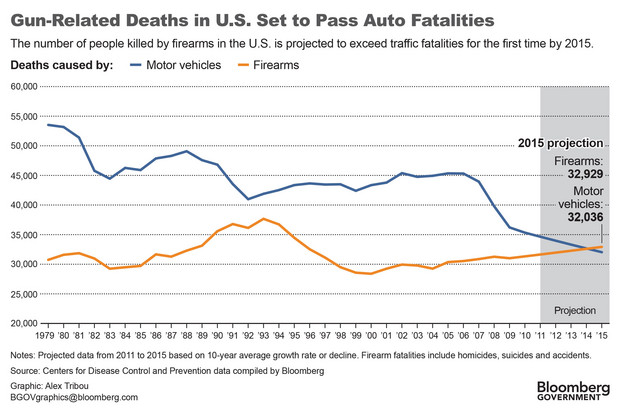
  • Chart of the day: U.S. gun and traffic deaths over time

      4 comments
      December 19, 2012 at 12:00 pm
      Austin Frakt

    Via Bloomberg:

    gun auto fatalities

    Even if deaths are a full measure of cost (and they are not), one should also consider the benefits. Per death, does society benefit more from cars or guns? What are the implications for public health in these two areas?

    @afrakt


    TwitterFacebookDiggDeliciousStumbleUponShare
      4 comments on this post
     
      Uncategorized
      cars, guns, public health
    • Comments (4)

    • by Floccina on December 19th, 2012 at 09:55

      Because homicide has been falling I am guessing that the rise in firearms deaths is due to suicide. Does anyone have the numbers on that?

      Reply

      [top]
      • by Austin Frakt on December 19th, 2012 at 12:43

        Try the CDC. Just a guess.

        Reply

        [top]
        • by Floccina on December 20th, 2012 at 15:26

          After some searching between work I found it:

          http://www.fbi.gov/about-us/cjis/ucr/crime-in-the-u.s/2011/crime-in-the-u.s.-2011/tables/expanded-homicide-data-table-8

          Homicide with a firearm is falling.

          Reply

          [top]
    • by Randy Ellis on December 20th, 2012 at 15:12

      Although not a statistical statement, there is a noticeable association between when the 1994-2004 assault weapon ban was in place and the observed decline in gun-related deaths. That ban also contained other provisions that will have affected availability of guns.

      A decline of more than six thousand deaths per year appears to be associated with that legislation over the ten years before it expired.

      View

      http://blogs.bu.edu/ellisrp/files/2012/12/Gundeaths.pdf

      Reply

      [top]

    Write a comment

    Click here to cancel reply.


    (Submission implies acceptance of comments policy.)

    Loading

  • Follow the blog

    rss Google+ twitter facebook facebook

    Why all these options?

  • TIE Books

    Don't Cross Your Eyes! Amazon.com
    Barnes & Noble
    Books-A-Million
    Borders
    IndieBound


    Don't Swallow Your Gum!
    Borders
    Barnes & Noble
    IndieBound
    Amazon.com
    Books-A-Million
  • Tag cloud

    AcademyHealth accountable care organizations Affordable Care Act announcement antitrust blogging books comic competitive bidding costs cost shifting deficit employer-sponsored health insurance health care costs health insurance health insurance mandates health reform hospital readmissions hospitals instrumental variables insurance exchange market power Massachusetts Medicaid Medicare mortality obesity On The Record physicians politics PPACA premiums premium support prescription drugs prostate cancer quality reading list reflex RWJF single payer spending substance use tax uninsured xkcd
Work posted here under copyright © of the authors.

Details on the Site Policies page.