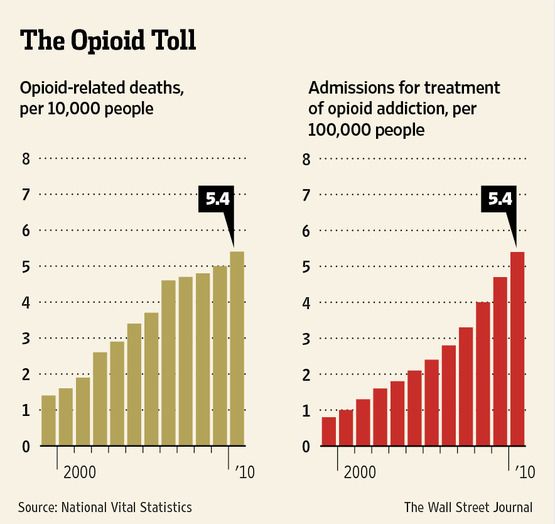
From a Wall Street Journal article that is worth reading in full:
Authors
-
Recent posts
- A conversation with Keith Humphreys on health reform, mental health, and substance abuse treatment
- Micro and macro totems
- Bias, validity, and terminology
- The sequester is hurting mental health research
- Delinkage
- Comparative Effectiveness at work (and a power dig)
- Bias and the Oregon Medicaid study
- “I am one of those who are very willing to be refuted”
- Preventive mastectomies are good for some, not for others
- The Oregon Experiment, Irrationality, and Universal Coverage
Archives
For speaking inquiries
Aaron’s stuff
Selected appearances:
The Colbert Report
Good Morning America
Sound Medicine (most recent)
The Ed Show
Austin’s stuff
Click here for a link to Austin's CV, as well as a complete list of his peer-reviewed publications with links to related posts and/or ungated versions (when available).
-
Chart of the day: Opiod toll
December 17, 2012 at 5:00 am
Austin FraktWrite a comment
Follow the blog
TIE Books
Tag cloud
AcademyHealth accountable care organizations Affordable Care Act announcement antitrust blogging books comic competitive bidding costs cost shifting deficit employer-sponsored health insurance health care costs health insurance health insurance mandates health reform hospital readmissions hospitals instrumental variables insurance exchange market power Massachusetts Medicaid Medicare mortality obesity On The Record physicians politics PPACA premiums premium support prescription drugs prostate cancer quality reading list reflex RWJF single payer spending substance use tax uninsured xkcd
Loading

by Frank Sinatra on December 17th, 2012 at 06:25
Well, that’s only a slightly misleading figure…
Fascinating article though.
by Paul Nelson on December 17th, 2012 at 22:48
There is a similar graph that charts the increase in narcotics sold annually as measured in pounds per citizen, yes, pounds not ounces. It is a very similar graph. Let’s all remember that each pound requires one or more written prescriptions, signed by a physician and dated within the last 6 months. I can not even guess how this healthcare problem could be solved? It probably begins by asking the question: who is the most co-dependent, the physician or the patient?
by Weiwen on December 18th, 2012 at 11:17
That is a good article.
On the one hand, a lot of people in long-term care do validly need opiates or other strong painkillers. Untreated pain is a major problem in facilities. The Drug Enforcement Agency’s actions have generally made it harder for nursing facility residents to get quick access to pain medications. For example, someone’s pain might spike after they get transferred in to a facility, but the pharmacy needs written authorization from an MD, and it can take time to get their hands on an MD. The MD can’t just verbally authorize an RN at the facility. There are medical conditions like spinal degeneration that cause severe and chronic pain. Whatever policy we set on drugs, we need to balance the harms of addiction against the severe pain that a minority of people suffer.
And on the other hand, if you make it easier for people to get opiate medications, you increase the risk for diversion: you make it easier to divert, you increase the supply of drugs flowing through the system so a diversion is more easily missed (also an argument I think might apply to gun control btw).
I’m not sure how the epidemiology of chronic pain versus opiate addiction works out. From the most recent National Survey of Drug Use and Health, it looks like about 10 percent or more of the entire population over age 12 abused opiates during the survey year (2010, I believe; very annoyingly, they report for ages 12 to 17 and 18 to 25, but not 25+, so 10 percent is a guesstimate).
http://www.samhsa.gov/data/nsduh/2k10nsduh/2k10results.htm#8.3
The IOM says that something like 100 million Americans have chronic pain, BUT they do not say how many have pain of a level that would rise to where they would need regular or irregular opiate prescriptions. Pain might be chronic enough to interfere with your work, but it might not be severe enough to warrant opiate management. On the other hand, the person with the degenerative spinal cord disease should probably get opiates. I’m at work so I’m not inclined to dig any further into this, but I’m guessing that only a small minority of the population with chronic pain should be on opiates – or am I wrong? Can anyone shed some light?
http://www.iom.edu/Reports/2011/Relieving-Pain-in-America-A-Blueprint-for-Transforming-Prevention-Care-Education-Research.aspx
http://www.ioam.org/statistics.html
By the way, any MDs know if there are any effective non-opiate painkillers that might be substituted for opiates?