
It’s clear to everyone that the Affordable Care Act (ACA) is what we’re calling health reform now, right? Good.
Anyway, Ezra Klein pointed readers to a handy pie chart from The Tax Foundation that shows where the money will come from to pay for ACA goodies. I agree with Klein that it would have been terrific if the creators had broken out the Medicare savings.
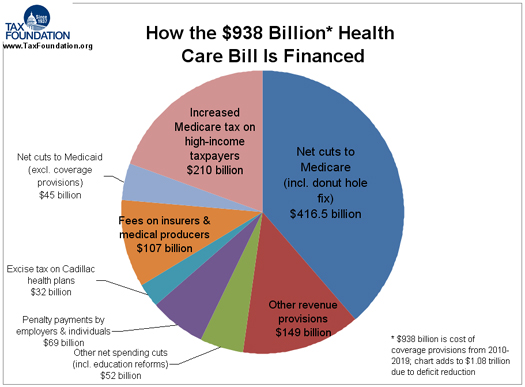
Taking a peek at the CBO scoring document it looks like about 43% of the Medicare cuts are in reductions in updates to fee for service rates, mostly for hospital payments I believe. About 30% is cuts in Medicare Advantage payments. The rest is a grab bag of other stuff each piece of which is small.


by blbarnitz on March 28th, 2010 at 11:32
Here is the breakdown according to the Tax Foundation;
Main Components in Net Cuts to Medicare ($416.5 billion)
Reductions in annual updates to Medicare FFS payment rates = $196 billion cut
Medicare Advantage rates based upon fee-for-service rates = $136 billion cut
Medicare Part D “donut hole” fix = $42.6 billion increase
Payment Adjustments for Home Health Care = $39.7 billion cut
Medicare Disproportionate Share Hospital (DSH) Payments = $22.1 billion cut
Revision to the Medicare Improvement Fund = $20.7 billion cut
Reducing Part D Premium Subsidy for High-Income Beneficiaries = $10.7 billion cut
Interactions between Medicare programs = $29.1 billion cut
Main Components in Other Provisions ($149 billion)
Associated effects of coverage provisions on revenues = $46 billion
Exclusion of unprocessed fuels from the cellulosic biofuel producer credit = $23.6 billion
Require information reporting on payments to corporations = $17.1 billion
Raise 7.5% AGI floor on medical expenses deduction to 10% = $15.2 billion
Limitations to the use of HSAs, MSAs, FSAs, etc. = $19.4 billion
Other Net Spending Cuts ($52 billion)
Education reforms = $19 billion cut, which is the difference between approximately $58 billion in spending reductions via reform of the student loan program and approximately $39 billion in greater spending on higher education programs, most notably Pell Grants
Community Living Assistance Services and Supports = $70 billion in cuts
Category is netted lower by increases in other health programs such as public health programs and spending on community health centers