
What Health Reform Is About: Real People, Real Needs

October 20, 2009 · by Austin Frakt · Posted in Health Policy 

We now stand on the threshold of historic reform of our health care system. But make no mistake, crossing that threshold, or doing so with the particular provisions in current legislation, is not a certainty. As legislators merge and amend the bills before them, it’s worth pausing for a moment and considering what this is all about: real people in real need–millions of uninsured and vulnerable Americans for whom successful reform would bring relief or for whom failure would bring additional years, possibly decades, of struggle.

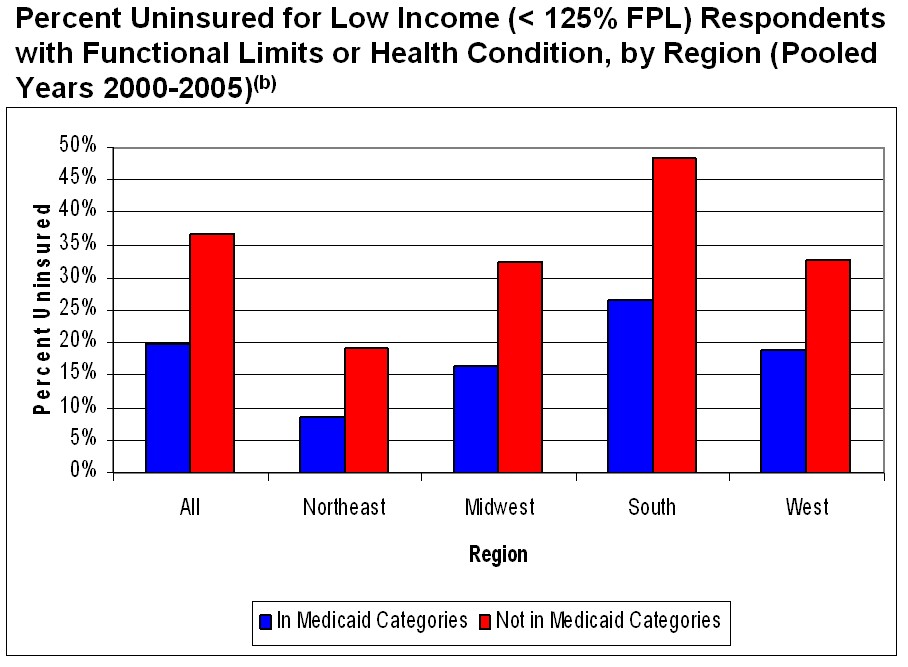
Research released today in the journal Health Affairs, by me with colleagues Steve Pizer and Lisa Iezzoni, shines light on a particularly vulnerable set of Americans in desperate need of health insurance and the access to care it would facilitate. In particular the study reveals that low-income people with chronic health conditions or disabilities can have outrageously high uninsurance rates, nearly 50% if they live in the south and do not qualify for public health programs (see figure below; click for larger, sharper image).
uninsured

How can so many low-income Americans be uninsured? It is a common misconception that a health care safety net—Medicaid—protects all such individuals. In reality, due to the design of the program and state variation in implementation, many fall through the cracks. We’ve all heard that the number of uninsured in America has been rising and that health reform would finally reverse that trend. We may be aware that we could lose our own insurance if we lose our jobs, develop a serious illness or disability, or both. What we may not be aware of is that the safety net of public insurance, the Medicaid program, is tremendously uneven and might not protect us if we really needed it.

Current federal law specifies that adults with low incomes and assets can qualify for Medicaid if they belong to specific federally defined eligibility categories including: old age, blindness, disability (narrowly defined), being pregnant, or having young children. That means that, in general, under federal law Medicaid may not cover individuals who do not fall into any of these categories no matter how low their income and assets or how seriously ill or functionally impaired they may be. The states have wide discretion in setting eligibility rules for these groups.

Even for those in the federal categories, states establish their own income and asset thresholds, which can vary substantially. For example, income thresholds for unemployed parents in 2009 were 21% of the federal poverty level (FPL) in Florida, 29% in Georgia, and 13% in Texas. Corresponding income thresholds were typically much higher in northeastern states: 150% in New York, 90% in Ohio, and 133% in Massachusetts (source: statehealthfacts.org).

The geographic and categorical variation in Medicaid eligibility is reflected in rates of uninsurance. The above figure from our study, based on publicly available Medicare Expenditure Panel Survey data, illustrates rates of uninsurance nationally and by U.S. region for two populations of low income individuals with functional limitations or serious health conditions: those in federal Medicaid categories (in blue) and those who are not in federal Medicaid categories (in red).

The sub-population of low income individuals with functional limitations or serious health conditions is small, about 6% of the working-age population. But it is a group that is in particular need of health insurance coverage, and as the figure shows, many members of the group fall through the holes in our health care systems’ safety net and are uninsured. Except for those in federally defined Medicaid categories in the northeast, uninsurance rates illustrated in the figure are above the U.S. population average of about 15% for the time period illustrated (2000-2005). For individuals not in federal eligibility categories and living in the south, the uninsurance rate is nearly 50%.

If health reform passes in something like its current form, Medicaid would become available to all individuals with incomes below 135-150% of the federal poverty level (source: The Henry J. Kaiser Family Foundation, “Side-by-Side Comparison of Major Health Care Reform Proposals”). Regional variation in uninsurance rates for low income individuals would be vastly reduced and the seemingly capricious eligibility distinctions that exclude so many chronically ill and disabled individuals would disappear. Expanding coverage for these groups would have profound implications for their health, as described in our paper.

As the debate over health reform grinds on it is worth keeping in mind what this is really all about. Those in desperate need of coverage who have fallen through the holes in the current system may not get as much attention as lawmakers and political tactics, but in reality they are far more important.

Software picked, likely related posts:

Comments

6 Responses to “What Health Reform Is About: Real People, Real Needs”

  1. Arthur_500 on October 20th, 2009 1:25 pm | permalink

    It is nice to support the least productive portion of our society. Our churches and other charitable organizations have been doing this for many decades. But is Insurance the answer to the Health Care debate?

    What exactly is the proportion of people who are uninsured, as I am, who feel a need to run to the doctor every week? How many of those people are productive members of our society? How many of those people choose to live a lifestyle that avoids health problems such as drinking and smoking? How much of the statistics are an actual problem and how much is simply wanting free healthcare?

    Insurance blinds individuals to the true cost of what they are receiving. Lower income individuals often have many health problems due to their own life choices. In other words the only benefit will come from a major restructure of the individual’s life. unless Medical care will do that these will be cost increases and not one efficiency gained.

    There is nothing in the current prograqm that will assist working individuals and in fact the proposal will result in a vast reduction in their income and quality of life. Even as you move up the income ladder you will take a while to get to a point where the cost of medical insurance is not an issue. The cost is just too high.

    Add in provisions such as removing any opportunity to charge a risk premium and the cost for all persons will rise. It has been reported it will rise an average of $600 and that includes major population States such as California and New York. Smaller markets will rise even more.

    There are many things I would like free and healthcare is one of them. However, is it the responsibility of our government to force all Americans to purchase inefficient, expensive health insurance? What are the unintended consequenses of trying to be nice?

  2. Austin Frakt on October 20th, 2009 2:54 pm | permalink

    @Aruthur_500 – You raise questions felt by many Americans. Fundamentally, why should “we” pay for the care of “others” who we view as having made “bad” life “choices?” I think those who are at least open minded to thoughtful debate will recognize all the loaded words and inherent bias in that question. Posing it that way (which you didn’t in words but did in spirit) almost invites an ideological fight (in which I will not partake or permit here), not a search for truth.

    The genuine answers are far too complex to address in one blog comment, or even one post. But they are out there. Regular reading of credible sources can illuminate the topic. In a week or so I will provide a complete list of all my regular news and information sources for the benefit of readers.

    Returning to the study that this post summarized, there is a large class of individuals without insurance and with disabilities and health issues beyond their control. Is it the duty of our society to care for them? That’s for each of us to decide.

  3. Mike on October 20th, 2009 6:26 pm | permalink

    @Austin – Aurthur raises good questions. While you interpret it as a loaded question, I don’t at all.

    There is a fundamental debate going on right now about who is responsible for helping others. Is helping others a requirement of our society? Or is it something we get to choose to do? Are we going to force all Americans to contribute to a particular charity? Is it limited to healthcare? Or does it extend to housing and food as well?

    When we provide too much gov’t support, some people take less responsibility for themselves. For instance, why is it that the American savings rate has consistently declined over the last 50 years? Could it be that Social Security provides a safety net such that Americans don’t feel the need to save? China has no such program, and they are great savers.

    Every time we create a new entitlement (SS, Medicare, now general Healthcare) we lock down the choices of future generations. Entitlements are never retracted – people come to depend on them and you simply can’t take it away. So we should not take on such complex decisions without thinking about the long term.

    But there are only a couple things we know about the long term:
    a) Health care costs will continue to skyrocket
    b) There is no plan in place to curb (permanently) healthcare costs

    Given that, it is just a matter of time before we can’t pay for the program. Why would we put this burden on our children? Give our children the choice for how to evolve this country. If you lock them into funding this entitlement program, you’re taking away their freedom.

    Why can’t we figure out how to curb costs FIRST and then figure out the entitlement program? Why do we have to first lock ourselves into a program which we know will drive us to bankruptcy? How will America compete globally when our people are taxed disproportionately while other countries do not do this?

    Freedom includes the freedom to fail. Let people fail. It’s okay. When you take away freedom to fail, you incidentally take away the freedom to succeed. That’s not where we want to be.

  4. Austin Frakt on October 20th, 2009 6:46 pm | permalink

    @Mike – Arthur used some loaded language. My post and paper are about individuals with disabilities and chronic illnesses. I do not consider it remotely fair or reasonable to use terms like “least productive” and “choose to live a lifestyle” with respect to those individuals or, in contrast, those without disabilities or illnesses. Those are his phrases, not mine. If he (or you) wish to have a debate about when, why, and how to provide health care (and pay for it), that’s fine, though not on this post. I will interpret comments on this post as being relevant to this post, as they should be.

    If you, he, or anyone else wishes to discuss how to provide insurance and health care to individuals in great need and low income, I welcome it here. If you wish to discuss other health care topics I likely have a thread of relevance in which to do so.

    (I’m not trying to be difficult. Look at it from my perspective for a moment. Entertaining topics of all sorts on all threads makes for a disorganized blog and an exhausted administrator. It isn’t good for readers or me.)

  5. Arthur_500 on October 21st, 2009 5:28 pm | permalink

    My intention is not to be mean-spirited or utilize loaded terminology. However, I do intend to duscuss what our society needs to do and what our society would like to do.

    I do not think inusrance is the answer to health care reform. At least many of our legislators are now calling it what it really is – Insurance Reform. however, they are not reforming the insurance systems of the United States.
    We have over 50 different governing bodies to oversee insurance. Insurance companies simply cannot provide affordable health insurance in many states. Couple that with a requirement that insurance companies cannot charge a risk premium and you have the makings of a disaster; We must all suffer with premiums based on the highest common denominator.

    Your wrote: “low-income people with chronic health conditions or disabilities can have outrageously high uninsurance rates, nearly 50% if they live in the south and do not qualify for public health programs.” I would tend to disagree with this assessment from a pragmatic stance if not official. People with disabilities do have coverage available to them as well as those who chose to go receive care and then not pay their bill. I came off as sounding mean-spirited when I said they were low-producing members of society. In reality, if they are unable to be productive because of their illness or disability then my description, although not politically correct, is not an incorrect one. We constantly support these folks when they are unable to pay their bill. However, it is the institution, the States and the Federal government that pick up the tab because it is not an official program to subsidize the low income individuals.

    The Plans being considered would require everyone to have Health Insurance and the government would subsidize those who could not afford it. This officially creates a program for paying for those who cannot afford it by subsidizing the insurance plan. At the same time it shifts those costs for the low-income to the Insurance companies and creates a hidden tax on those not being subsidized.
    It would be more honest to increase the income taxes by 50% and create a program to pay for those who could not pay their medical bills.

    All of this will do nothing to lower the cost of medical care in the United States.

    I say we need to reform health insurance so the insurance companies can build larger pools of individuals which will lower the cost to all.

    Honestly create a program to reimburse those medical providers who are unable to collect their fees.

    Encourage individuals to purchase insurance

    Every time you create a subsidy you create an artificial floor above which the affected providers will set their rates. If no one can afford a doctor at $100 per hour then the doctor reduces his rates or goes out of business. If you say you will subsidize the rate at 50% the doctor can raise his rates to $150 and consider the extra $50 a fee for dealing with a bureaucracy. Why should he reduce his rates or keep them the same?

    I would love to have everything I wanted for free but that is not reality. The Plans being discussed do not consider the reality of human interaction (economics) in the face of scarcity. Since the Plans will do more harm than good I feel they are not appropriate and tugging at my heartstrings by saying we need to buy insurance for handicapped and disabled individuals is simply not supported with real analysis.

    I do, however, apologize if I sound like I hate people and we need to invoke Hitler and eliminate non-productive members of society. This is neither how I believe nor how I wish the discussion to evolve.

  6. Austin Frakt on October 21st, 2009 5:53 pm | permalink

    @Arthur_500 – You raise a lot of issues. Am I right to infer that your primary concern is cost? That concerns me too. With consideration of basic fairness and within the realm of the politically feasible I prefer a more efficient use of taxpayer dollars. I don’t expect to get everything for free, but I also do not expect we can have a perfectly efficient system or one that does not include some additional cost for the establishment of safety-net programs that perform as insurance for all of us.

    I’d be interested in your specific ideas about politically feasible ways to address your concerns, perhaps in the context of current health reform legislation. Like it or not, that’s what’s on the table. That’s where you and I can make a mark, if anywhere.

Leave a Reply


Comments are moderated. See the comments policy.