Association only, and the paper is ungated.
Authors
-
Recent posts
- Compounding pharmacy bills
- Copayments are stupid, ctd.
- Should very young children be taking stimulants?
- GDP vs health care spending
- The medical device tax needs to stay
- More comparative effectiveness goodness
- Fluoridation
- How to debate a wing nut
- Chart of the day: Cognitive ability and enrollment into public programs
- Cutting the budget for inspections of compounding pharmacies
Archives
For speaking inquiries
Aaron’s stuff
Selected appearances:
The Colbert Report
Good Morning America
Sound Medicine (most recent)
The Ed Show
Austin’s stuff
Click here for a link to Austin's CV, as well as a complete list of his peer-reviewed publications with links to related posts and/or ungated versions (when available).
-
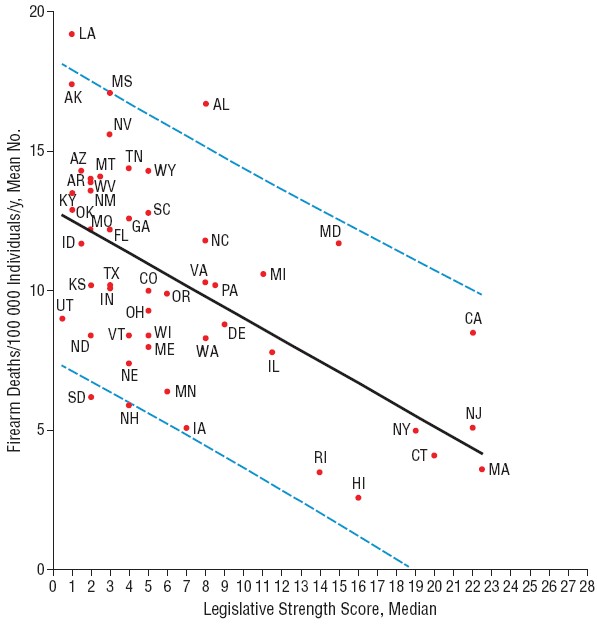
Chart of the day: State legislation and firearm deaths
March 6, 2013 at 6:00 pm
Austin FraktWrite a comment
Follow the blog
TIE Books
Tag cloud
AcademyHealth accountable care organizations Affordable Care Act announcement antitrust blogging books comic competitive bidding costs cost shifting deficit employer-sponsored health insurance health care costs health insurance health insurance mandates health reform hospital readmissions hospitals instrumental variables insurance exchange market power Massachusetts Medicaid Medicare mortality obesity On The Record physicians politics PPACA premiums premium support prescription drugs prostate cancer quality reading list reflex RWJF single payer spending substance use tax uninsured xkcd
Loading

by joeyjojo on March 7th, 2013 at 13:32
From the abstract:
“States in the highest quartile of legislative strength (scores of ≥9) had a lower overall firearm fatality rate than those in the lowest quartile (scores of ≤2) (absolute rate difference, 6.64 deaths/100 000/y; age-adjusted incident rate ratio [IRR], 0.58; 95% CI, 0.37-0.92). Compared with the quartile of states with the fewest laws, the quartile with the most laws had a lower firearm suicide rate (absolute rate difference, 6.25 deaths/100 000/y; IRR, 0.63; 95% CI, 0.48-0.83) and a lower firearm homicide rate (absolute rate difference, 0.40 deaths/100 000/y; IRR, 0.60; 95% CI, 0.38-0.95).”
It seems the highest quartile had 6.64 more gun deaths per 100,000 peron years than the lowest quartile. 6.25 per 100,000 of those deaths were gun-related suicides. 0.4 of the deaths were firearm homicides.
Haven’t read the full paper, but I’d be interested to see if non-firearm suicide rates were much higher in the lowest quartile. I guess if someone is going to attempt suicide, though, we’d rather they did it via non-firearms means, as they would then be more likely to survive the attempted suicide and potentially receive rehabilitative treatement to get them off the suicide path.
If N people attempt suicide via firearm, and N people attempt suicide via non-firearm methods, how will the survival rates compare?
by Floccina on March 11th, 2013 at 10:17
What we really need to look at are state legislation charted against total homicides and total suicides (also by race would be nice for obvious reasons). I would guess that there would still be a correlation especially with suicides but that it would be smaller. Charts like the above make me wonder why the source of chart ignored what would show a much more important relationship.