
Marginal Versus Average Tax Rate Figures

November 19, 2009 · by Austin Frakt · Posted in Economics 

I don’t need to write a post on the difference between marginal and average income tax rates. There are already perfectly good explanations available elsewhere (see list at the end of this post). In brief, your marginal tax rate is the tax paid on the last dollar earned. Often this is what people mean when referencing their “tax bracket.” Your average tax rate is simply your tax paid divided by your taxable income.

The purpose of this post is to show off graphs that illustrate the difference between marginal and average federal income tax rates (state and payroll taxes excluded). A while back I wanted graphs like this but couldn’t find any online. So I made them myself. They’re included below and also in an online Excel spreadsheet that has the data on which they’re based. All figures and data are for federal income tax for the 2009 tax year.
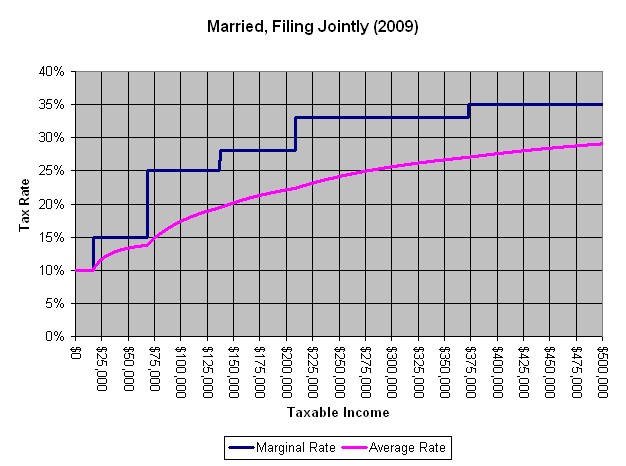
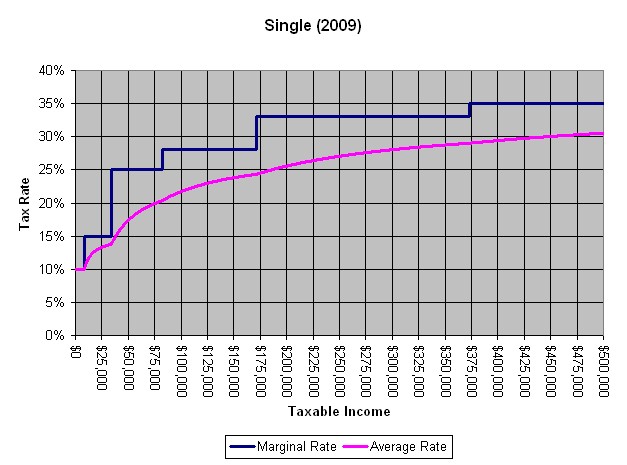
marriedsingle

For more on marginal versus average tax rates see any of:

Software picked, likely related posts:

Comments

5 Responses to “Marginal Versus Average Tax Rate Figures”

  1. TFB on November 19th, 2009 9:02 am | permalink

    Like so many other articles on this subject, you are not showing the true marginal and average tax rates. The true marginal and average tax rates include FICA and state and local taxes.

  2. Austin Frakt on November 19th, 2009 10:36 am | permalink

    @TFB – Indeed, which is why I had written “federal income tax” in the post. But I take your point and updated the post to make it explicit that payroll and state taxes are not included. Payroll taxes wouldn’t be hard to add. State taxes would have to be considered individually. I’m not going to produce 50 to 100 graphs, and the spreadsheet is available so anyone is free to improve or personalize this. (As I said, I did these for my own need and am providing them because I can.)

    Having said all that, over a broad range FICA is a flat tax. Same goes for many state taxes. In such cases they would add a vertical shift to the figures. The shapes of the curves would remain the same.

    Although, there is a complexity that I avoided but one you may have to consider to do FICA right and perhaps some state taxes. The base may be different. Does FICA apply to the same base (taxable income on the 1040) as federal taxes? Are there no deductions that result in a taxable income below that which is hit by payroll taxes?

  3. TFB on November 19th, 2009 11:32 am | permalink

    “Does FICA apply to the same base (taxable income on the 1040) as federal taxes?” – No. FICA applies to wages and self-employment income.

  4. Austin Frakt on November 19th, 2009 11:50 am | permalink

    @TFB – Thanks. That’s what I thought. My question was largely rhetorical. It was meant to cause readers to contemplate why it isn’t that easy to produce figures like the ones I did that include FICA and are also perfectly accurate and relevant to all taxpayers.

  5. Ian Crosby on November 19th, 2009 1:45 pm | permalink

    The larger point is that so many people just don’t get the concept of marginal vs. effective rates of taxation. Witness the man-in-the street interviews from last year’s election with people concerned about holding their income below $250k if Obama were elected, as if the higher marginal tax rates he proposed would somehow apply to all of their income if they exceeded that threshold.

Leave a Reply


Comments are moderated. See the comments policy.